Wednesday, September 28, 2005

Día Mundial de Turismo

World Tourism Day announced itself a sunny, clear Tuesday in Cochabamba. We set up our booth with posters about natural resources and listed the “Leave no Trace” slogan translated into Spanish. We were one of the only educational booths, not offering package deals to the Chapare region or Amazonia, but instead offering games and conversation about responsible travel and saving what little natural resources we have left. The theme was Travel and Transportation, celebrating the centennial of Jules Verne’s death in 1905. This was a quote that struck me: “En 1950 eran veinte millones, el año pasado 760, y para 2020 se calcula que el número de los viajeros
internacionales superará los 1.600 millones anuales. “ Basically saying that the amount of travelers worldwide in 1950 was 20 million and by the year 2020 that number will be up to 1.6 billion. Our booth was one of the most popular, kids enjoyed the games and adults were fascinated with what the gringos had to say; I also think that the engaging manner of standing in front of our table, willingly entering conversations (and apologetically declining offers for dinner and tours around the town) was an approach unlike any Bolivians are used to.
What amazed me was the success of our presentation with the bare minimum supplies (markers, chart paper, poster board, and candy). PowerPoint, color copies, laminations, brochures, and advanced technology were not an option, and in hindsight would have been extremely unnecessary. The best part, however, was looking at my watch and realizing that Shannon, Sarah, and I had conversed with hundreds of people in Spanish for a 5 straight hours! I remember staring up through the jacaranda trees in the main plaza and thinking how lucky I was to be able to do this only a month after arriving in-country!
The days are getting warmer and my village of Bella Vista is getting ready for its annual festival. Each night in the church square, people are dancing the tinku, diablada, caporale, and cueca- all practicing for the big weekend. Unfortunately the same weekend we leave on our “tech week,” traveling to different sites and visiting current volunteers and observing their work. Tomorrow I am giving a presentation to 8th graders at the middle school about renewable natural resources and the physical characteristics of Bolivia; I hope to learn as much from them as I am teaching them- especially considering most of my information is out of a textbook and not through experience like them.
In other news, I have undergone a new Bolivian haircut, learned new card games, wandered aimlessly in Cochabamba, and fall more and more in love with Bolivia each day I wake up. I hear of my site announcement in about 2 weeks and am anxious to find out my new home!

Monday, September 19, 2005

Top 10...

Top 10 things I have learned this week in Bolivia:

10.When life breaks your camera, you start noticing things and paying more attention to the scenery that passes you by…
9. I am not as immune to amoebas and parasites as I thought I was…
8. Some of the best ice cream I have ever had hails from Cochabamba…
7. Trying to open a wine bottle with a utility knife is NEVER a good idea…
6. My favorite meal is Milanesa- a filet of beef breaded and fried with egg batter- and Relleno de yuca with queso…
5. Hand-washing my laundry, while much more time-intensive, is also much more effective…
4. Running every morning on a grassy path alongside the mountains while women pick their gladiolas to sell at the market sure beats running on a treadmill…
3. It costs $2,000 for a family in the campo to have a landline telephone…
2. There is a good chance I will be working at a site where I would be promoting a tourist destination along a CHE (Guevara) tour…
1. “Capacitar” does not translate into English (like I thought it would) as “ to brief someone on a specific topic”, but instead “to prepare a female, usually a cow, for fertilization”…

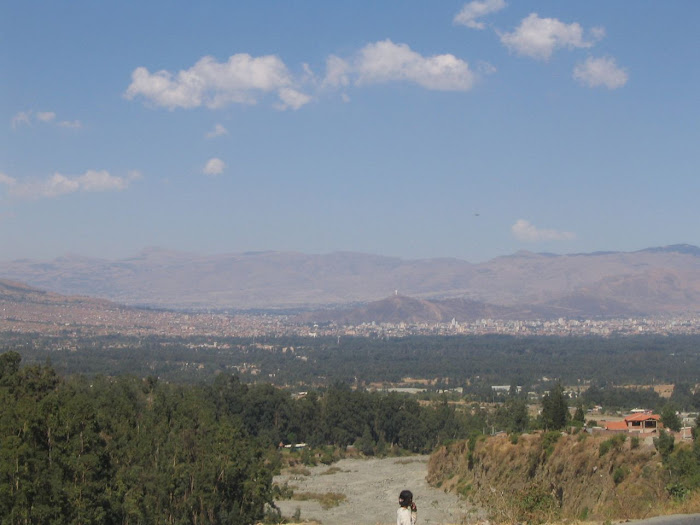
As you can tell, things have been going well for me… there is still nowhere else I would rather be despite the mishaps and cultural faux pas that I have encountered. Today we went to the famous Virgen de Urkupiña, where there were apparitions of the Virgin Mary. Every year on the feast of the Assumption there is a large festival and pilgrimage to this church. Farther to the south of Quillacollo, there are ancient ruins of silos where grains, maize, and even personal belongings were stored. They were placed very symmetrically according to the wind direction, and are located high atop a plateau- a view which yields an awesome sighting of Cochabamba and the large Christo statue.
Sunday, I went to mass at the Cathedral in Cochabamba. Built in the late-16th century, most of what remains today is restored and not original, but beautiful nonetheless! The plaza adjacent to it, Plaza de 14 de Septiembre is quite the gathering place on Sundays-for the young and old, rich and poor; jewelry vendors, ice cream carts, and shoe shiners all cluster in the park underneath the beautiful jacaranda trees; at times its nice to just roam and feel like a tourist and not like a resident!